



Description
Rubber Supports with Through-Hole for Screw or Rivet Fastening
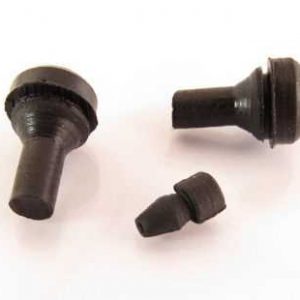
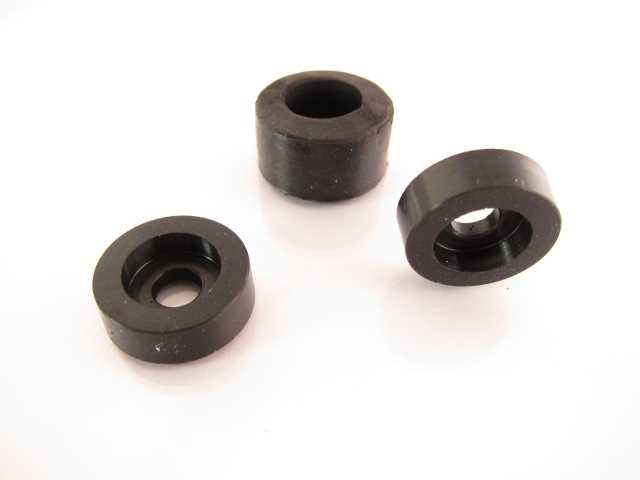
Barbieri Rubber rubber supports are elastic solid rubber blocks with a through-hole, designed for direct fastening with a screw or rivet, without metal insert. They are catalog parts available in multiple sizes and hardnesses, used for vibration isolation, contact-surface protection, and absorption of impacts between mechanical elements.
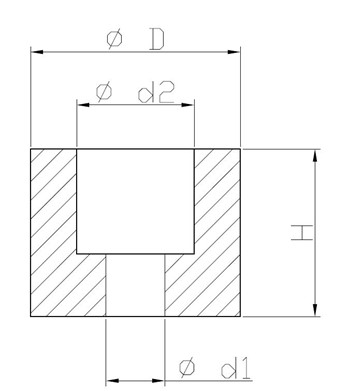
| Code | D | H | d1 | d2 |
| APP06 | 24,5 | 6 | 3 | 13 |
| APP05 | 16 | 5 | 5 | 9,5 |
| APP08 | 20 | 8 | 5 | 11,5 |
| APP11 | 17,5 | 9,5 | 5 | 10 |
| APP15 | 20 | 15 | 5 | 12 |
| APP16 | 21 | 16 | 5 | 10 |
| APP20 | 45 | 20 | 7 | 20 |
| APP24 | 25 | 24 | 5 | 11 |
| APP25 | 30 | 25 | 6 | 11 |
What rubber supports are used for
Rubber supports are used as elastic supports between two surfaces, as spacers, to isolate vibrations from light machinery, to protect contact surfaces from impacts and friction, and to absorb small oscillations. The through-hole allows fastening with a screw or rivet that passes through the rubber block and anchors to the frame. Unlike anti-vibration feet with a threaded metal insert, rubber supports are entirely made of rubber and have no metal parts embedded in the compound.
Available compounds and typical hardness
The standard compounds are NR/SBR for general-purpose applications, NBR for environments with oils, EPDM for outdoor and UV exposure, and VMQ silicone for high temperatures. Typical hardness ranges from 60 to 80 Shore A: higher hardness increases load capacity and stability, medium hardness increases vibration absorption and surface adhesion.
Standard catalog version and custom designs
The standard range of rubber supports covers the most recurring diameters and hole sizes, with active molds at Barbieri Rubber and no tooling cost for the customer. For custom geometries (dedicated shapes, multiple holes, special compounds, marking) we produce rubber supports to drawing: at least a preliminary drawing from the customer is required. The dedicated mold is then built in cooperation with trusted tooling partners.
Frequently asked questions
What is the difference between a rubber support and an anti-vibration foot?
Rubber supports are solid rubber blocks with a through-hole for screw or rivet fastening, without metal insert. Anti-vibration feet, on the other hand, typically have a threaded insert co-molded into the rubber. Rubber supports prioritize elastic isolation between surfaces, while anti-vibration feet prioritize threaded anchoring to a frame.
Does the rubber support have a metal insert?
No. Rubber supports are entirely made of solid rubber, with no inserts or embedded metal parts. The through-hole is used to pass the fastening screw or rivet, which goes through the rubber block and anchors on the other side.
Are they available from stock?
Yes, the most recurring sizes and hole formats are standard catalog parts kept in stock, with no tooling cost for the customer. For special sizes we switch to the to-drawing version.
Do they resist aggressive environments?
Yes, by selecting the correct compound. NBR for oils, EPDM for outdoor and UV, VMQ silicone for high temperatures, FKM (Viton®) for aggressive chemicals.
Which hardness should I choose?
Typically 60-80 Shore A. Higher hardness increases static load capacity, medium hardness increases vibration absorption and surface adhesion.