



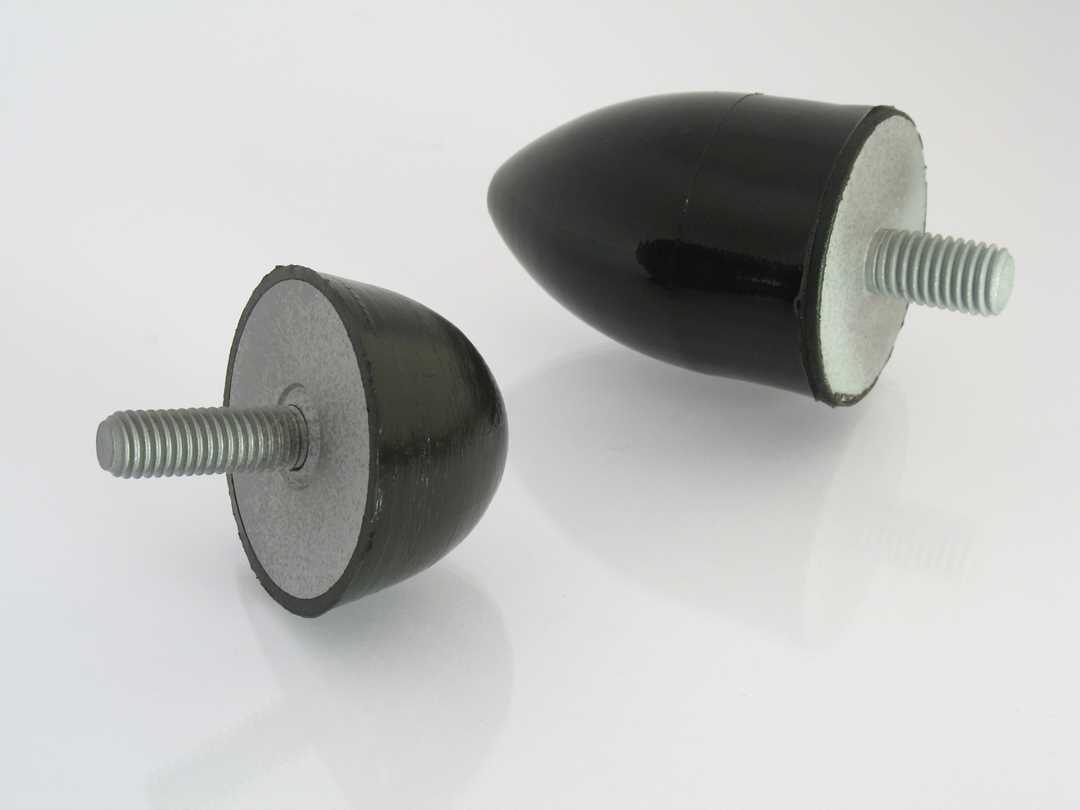
Description
Parabolic Rubber Shock Absorbers with Threaded Insert
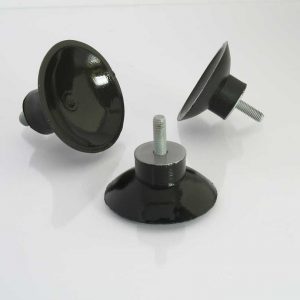
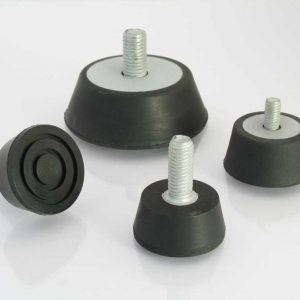
Barbieri Rubber parabolic shock absorbers are anti-vibration supports with parabolic profile and threaded metal insert. The parabolic shape delivers a strongly progressive stiffness characteristic: high compliance at low loads and continuously increasing stiffness as deflection grows. They are catalog rubber components, available in multiple sizes and hardness.
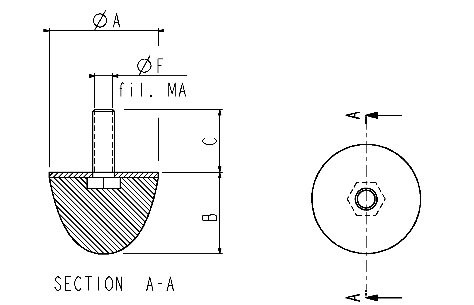
| Code | Ø A (mm) | Height B (mm) | Screw C (mm) | Thread F (mm) | Max Load (Kg) |
| SATP4030PM845 | 40 | 30 | 23 | M8 | 70 |
| ANT PAR 50/50 | 50 | 50 | 35 | M8 | 70 |
What a parabolic shock absorber is for
Parabolic shock absorbers are the technical choice when a strongly non-linear stiffness behavior is required: initial compliance to damp small-amplitude vibration, and increasing stiffness to support high static loads or dynamic peaks. They are an optimal compromise for assemblies with mixed vibration profiles, such as combustion engines, industrial compressors, generators, presses, pumps and equipment combining static load and variable-amplitude vibration.
Available compounds and typical hardness
Standard compound for parabolic shock absorbers is SBR for general applications, NBR for oil exposure, EPDM for outdoor, VMQ silicone for high temperatures, FKM (Viton®) for chemically aggressive environments. The parabolic geometry works well with medium compounds because it operates intrinsically in a progressive way.
| Compound | Temperature range | Feature | Typical applications |
| SBR | -20 / +90 °C | Good mechanical balance | General-purpose feet |
| NBR (Nitrile) | -40 / +130 °C | Resistance to mineral oils | Workshops, hydraulics |
| EPDM | -40 / +100 °C | UV, ozone, outdoor resistance | Outdoor, photovoltaic |
| VMQ (Silicone) | -60 / +200 °C | High temperatures | Ovens, hot environments, food-grade |
| FKM (Viton®) | -10 / +180 °C | Aggressive oils and solvents | Chemicals, automotive |
Catalog standard version and custom designs
The most recurrent sizes and threads of parabolic shock absorbers are standard catalog rubber components in stock at Barbieri Rubber, with no tooling cost for the customer. For non-standard sizes or threads, special compounds and dedicated hardness, we produce custom parabolic shock absorbers: at least a preliminary drawing from the customer is required. The dedicated mold is manufactured in cooperation with our trusted toolmaking partners.
Industrial applications
Parabolic shock absorbers are used on generators, industrial compressors, combustion engines, presses, pumps, test benches, fans and unbalanced rotating units. They are valued for applications combining significant static load with variable-amplitude vibration: the parabolic profile maximizes damping efficiency over the entire working range.
Frequently asked questions
When should I choose a parabolic shock absorber?
When the supported system has highly variable vibration amplitude, dynamic peaks or when strongly progressive stiffness is required. Parabolic shock absorbers cover a wider load and deflection range than equivalent cylindrical feet.
What is the difference between parabolic and cone?
Both cone and parabolic show progressive behavior, but parabolic ones have a more pronounced progressivity and a wider working range. Cone feet are easier to size for applications with moderate load variation.
Are parabolic shock absorbers available from stock?
Yes, the most recurrent sizes are catalog rubber components, with no tooling cost. For special sizes we produce custom versions with a dedicated mold.
Which hardness is recommended?
Typically 50-70 Shore A. The parabolic geometry inherently provides progressive stiffness, so medium-hardness compounds already deliver effective dynamic behavior.
Is the threaded insert co-molded with rubber?
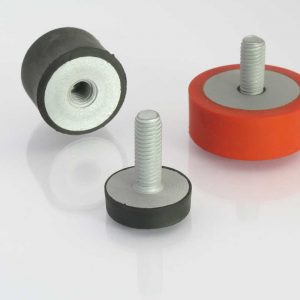
Yes. Production uses rubber-to-metal bonding: the insert is placed in the mold and rubber vulcanizes directly onto it, ensuring a stable bond suitable for industrial use.