



Description
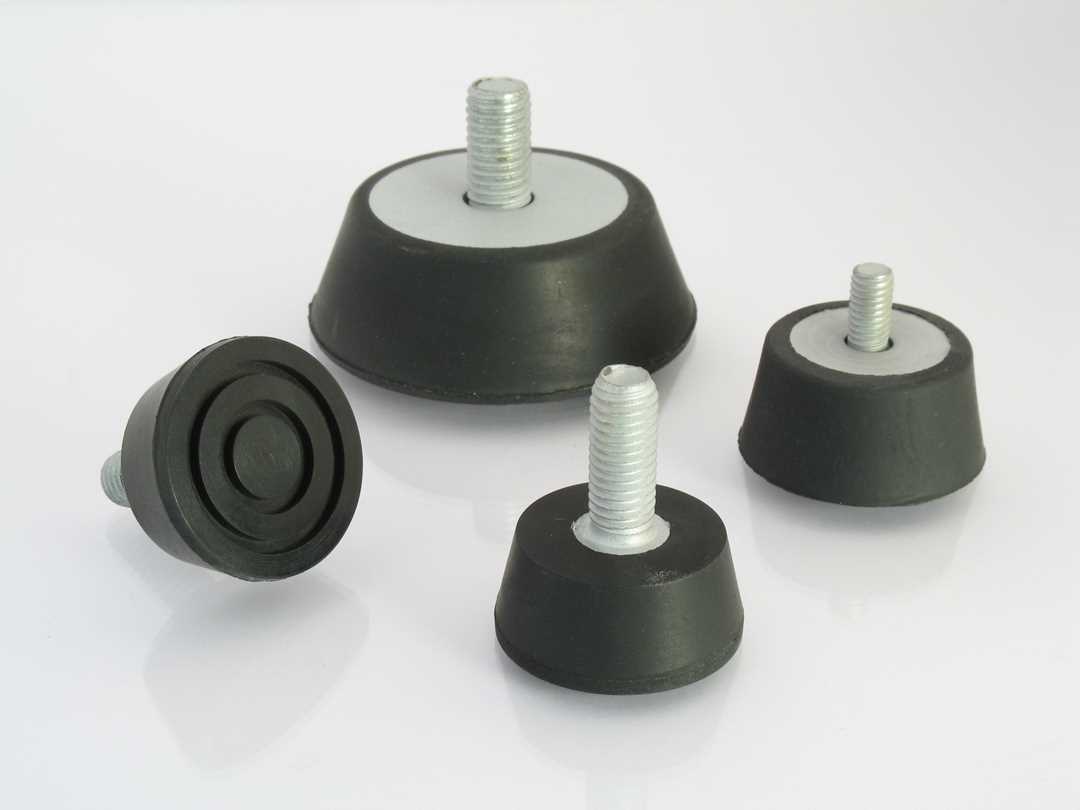
Cone Rubber Feet with Threaded Insert
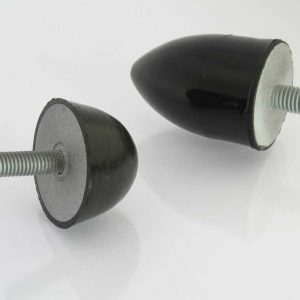
Barbieri Rubber cone rubber feet are anti-vibration supports with truncated-cone cross-section and threaded metal insert. The cone shape provides a progressive force-deflection curve: stiffness increases non-linearly with load, allowing effective damping at low loads and better shock absorption at peaks. They are catalog rubber components, available in multiple sizes and hardness, with metric threads.
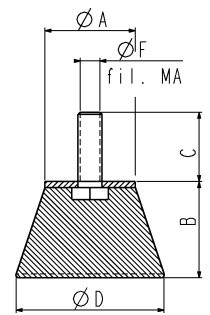
| Code | Ø A (mm) | Ø D (mm) | B (mm) | Screw F (mm) | C (mm) | Max Compression Load
(Kg) |
| PIE 30/13PM8 | 25 | 30 | 13 | M8 | 19 | 45 |
| PIE 30/26PM6 | 26 | 30 | 22 | M6 | 10 | 48 |
| PIE 34/16PM6 | 28 | 34 | 16 | M6 | 10 | 50 |
| PIE 40/20PM8 | 29 | 40 | 20 | M8 | 18 | 70 |
| PIE 37X50PM8 | 38,5 | 50 | 36 | M8 | 18 | 90 |
| PIE 50/20PM10 | 46 | 60 | 20,5 | M10 | 27 | 150 |
What a cone foot is for
Cone feet are chosen when vibration isolation must come with good shock damping, or when static load has significant variability. Typical on machines with unbalanced motors, compressors, pumps, rotating units and equipment subject to variable-amplitude vibration. The cone section also delivers a taller foot for the same base footprint, useful where the chassis must be raised above the floor.
Available compounds and typical hardness
Standard compound for cone feet is SBR; NBR for oil exposure, EPDM for outdoor and photovoltaic, VMQ silicone for high temperatures, FKM (Viton®) for chemically aggressive environments. The cone shape works well with medium hardness because progressive stiffness compensates initial compliance.
| Compound | Temperature range | Feature | Typical applications |
| SBR | -20 / +90 °C | Balanced mechanical performance | General-purpose feet |
| NBR (Nitrile) | -40 / +130 °C | Mineral oil resistance | Workshops, hydraulics |
| EPDM | -40 / +100 °C | UV, ozone and outdoor resistance | Outdoor, photovoltaic |
| VMQ (Silicone) | -60 / +200 °C | High temperature | Ovens, hot environments, food |
| FKM (Viton®) | -10 / +180 °C | Aggressive oils and solvents | Chemical, automotive |
Catalog standard version and custom designs
The standard range of cone feet covers the most recurrent sizes and threads, with active tooling at Barbieri Rubber and no tooling cost for the customer. For special sizes, hardness or compounds, we produce custom cone feet: at least a preliminary drawing from the customer is required, with base dimensions, height, thread and target compound. The dedicated mold is manufactured in cooperation with our trusted toolmaking partners.
Industrial applications
Cone feet are used on compressors, pumps, rotating units, motors, test benches, industrial fans, chillers, condensers, generators and workshop equipment. They are valued in applications where the machine transmits variable-amplitude vibration: the progressive characteristic of cone feet damps shocks and load peaks more effectively than equivalent cylindrical feet.
Frequently asked questions
When should I choose cone feet instead of cylindrical ones?
Cone feet are preferred for variable loads or vibration peaks: their progressive stiffness damps shocks better. Cylindrical feet have more constant stiffness and are preferred when predictable linear behavior is required.
Are cone feet available from stock?
Yes, the most recurrent sizes and threads are catalog rubber components, with no tooling cost for the customer. For special sizes or threads we produce custom versions with a dedicated mold.
Is the threaded insert co-molded with rubber?
Yes. Production uses rubber-to-metal bonding: the insert is placed in the mold and rubber vulcanizes directly onto it, ensuring a stable bond.
Can I order cone feet in special compounds?
Yes. On request we produce cone feet in NBR, EPDM, VMQ silicone, FKM (Viton®) or other special compounds for environments with oils, solvents, high temperatures or outdoor exposure.