








Description
Rubber Bellows: Cylindrical, Rectangular and Cone
Barbieri Rubber has been manufacturing rubber bellows since 1963 — cylindrical, rectangular, conical and modular — for protection of shafts, spindles, rods and moving parts in industrial environments. As a rubber bellows manufacturer based in Reggio Emilia, Italy, we produce standard catalog items and custom rubber bellows made to customer drawing, in NBR, EPDM, silicone (VMQ), neoprene and other technical compounds. All molding is carried out in-house in our plant in Emilia-Romagna.
Rubber bellows types
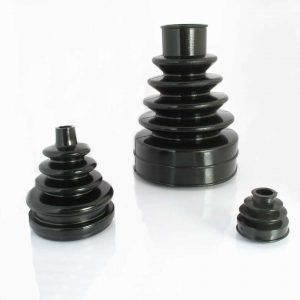
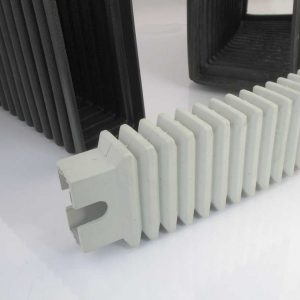
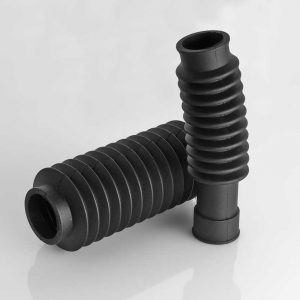
The rubber bellows range includes four main product families. Cylindrical rubber bellows protect circular-section components — spindles, rods, rotating shafts, hydraulic cylinders — with a corrugated profile that compresses and extends to follow the stroke. Modular bellows are assembled from single elements to cover variable lengths and irregular geometries: the standard solution for telescopic guides and custom strokes. Rectangular rubber bellows cover square and rectangular guides on machine tools and industrial equipment. Conical rubber bellows connect sections of different diameter and follow angular deflections, used in linkages, joints and articulated mechanisms.
Rubber bellows for shaft and spindle protection
Rubber protective bellows are the standard solution for shaft and spindle protection in machine tools, CNC machining centres, hydraulic and pneumatic cylinders, and industrial automation equipment. The key function is threefold: retaining lubricant near moving parts, preventing swarf, metal dust, coolant and aggressive fluids from entering the protected zone, and absorbing minor misalignments and oscillations. For applications with heavy metal dust — milling, grinding, turning — we select abrasion-resistant compounds and geometries optimised for swarf evacuation. Joystick rubber boots are a dedicated product within this family, produced for control levers in agricultural machinery, construction equipment and industrial vehicles.
Available compounds
NBR bellows are the industrial standard for contact with mineral oils: used in hydraulic systems, oil-hydraulic components, automotive and heavy machinery. EPDM rubber bellows resist water, steam, ozone and UV — the choice for outdoor installations, photovoltaic systems and water-hydraulic circuits. Silicone (VMQ) bellows cover the widest operating temperature range (-60/+200 °C), suited to food industry, medical applications and high-temperature environments. FKM (Viton®) is available for chemically aggressive conditions — aggressive oils, solvents, fuels. Neoprene provides a good general-purpose balance between chemical and mechanical resistance. Compound and hardness are selected based on operating environment, stroke, frequency and service life requirements.
| Compound | Temperature range | Chemical resistance | Typical applications |
| NBR (Nitrile) | -40 / +130 °C | Mineral oils, fuels | Hydraulics, automotive |
| EPDM | -40 / +100 °C | Water, steam, ozone, UV | Hydraulics, outdoor, photovoltaic |
| VMQ (Silicone) | -60 / +200 °C | High temperature, biocompatible | Food, medical, high-T |
| FKM (Viton®) | -10 / +180 °C | Aggressive oils, solvents, fuels | Chemical, automotive, hydraulics |
| HNBR | -20 / +160 °C | Oil + high temperature | Heavy-duty hydraulics |
| NR / SBR | -50 / +90 °C | Good mechanical elasticity | Anti-vibration, general |
Standard and made-to-drawing bellows
The standard catalog covers the most requested diameters, heights and compounds, with active molds and no tooling cost for the customer. For specific geometries — non-standard diameters, variable cross-sections, rubber-to-metal bonded inserts, custom flanges — we produce custom rubber bellows and industrial rubber bellows starting from the customer’s drawing, even at a preliminary stage. A draft drawing with the main dimensions and operating conditions is the minimum requirement for any custom production. Mold manufacturing is carried out with qualified toolmaking partners; all molding is in-house. Minimum quantities and lead times are agreed based on mold complexity and compound selection.
FAQs
What are rubber bellows?
Rubber bellows are molded elastic parts with a corrugated accordion profile, manufactured to protect shafts, spindles, rods and moving parts from dust, swarf, dirt, coolant and lubricant loss. The corrugated geometry allows the bellow to compress and extend — following the stroke of the protected component — while maintaining a continuous protective seal around the moving part.
Which rubber bellows types does Barbieri Rubber produce?
We produce four main types: cylindrical (circular cross-section, for spindles and rods), modular (assembled from single elements for variable strokes), rectangular (square or rectangular cross-section, for linear guides on machine tools) and conical (connecting sections of different diameter). We also manufacture joystick rubber boots for control levers and rubber bellows for elastic joints with specific mating dimensions.
Which compound should I choose for bellows?
NBR is the standard for mineral oils in hydraulics and automotive applications. EPDM suits water, steam, ozone and UV — ideal for outdoor and hydraulic systems. Silicone (VMQ) covers the widest temperature range (-60/+200 °C) and food or medical requirements. FKM (Viton®) resists aggressive oils, solvents and fuels. Neoprene is a general-purpose alternative. The compound is selected based on the fluids present, operating temperature, and mechanical demands of the application.
Can I order custom rubber bellows?
Yes. We produce custom rubber bellows and industrial rubber bellows from any drawing supplied by the customer, even at a preliminary stage — with at least the main dimensions (extended length, compressed length, inner bore, outer diameter, wall thickness) and the operating conditions. The dedicated mold is built with our toolmaking partners; molding is fully in-house. We handle the entire production cycle from compound selection to finished part.
Are Barbieri Rubber bellows suitable for CNC machine tools?
Yes. Rubber bellows for spindle and axis protection are among our core products for the machine tool sector. For CNC machining centres, milling and grinding machines, we produce rubber protective bellows in abrasion-resistant compounds, dimensioned for the specific stroke and guide geometry. We also produce rubber bellows for hydraulic and pneumatic cylinders used in CNC equipment.