



Description
Rectangular Rubber Bellows for Slides, Guides and Non-Circular Components
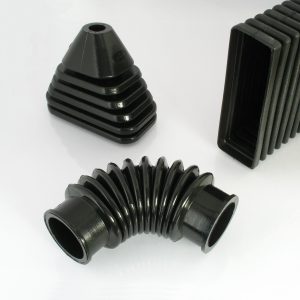
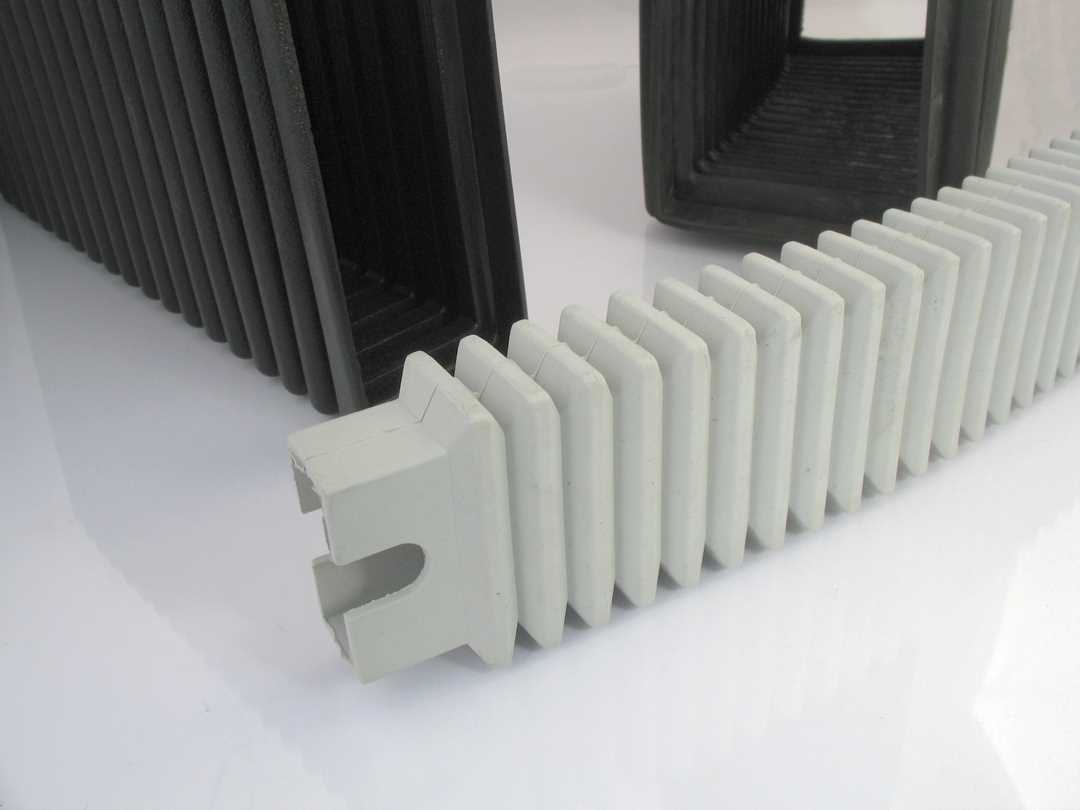
Barbieri Rubber rectangular rubber bellows are flexible protections with rectangular or square cross-section, designed to cover rods, slides, guides and moving parts that are not cylindrical. The rectangular shape suits prismatic seats, linear guides, flat profiles and couplings where a cylindrical bellows cannot be applied. They are standard catalog rubber components, but are often produced as custom rubber bellows for specific dimensions and geometries.
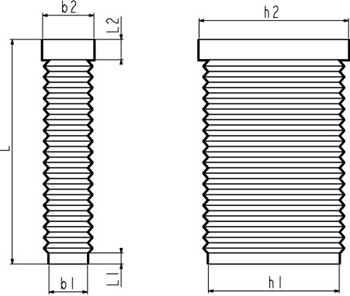
| Code | B1 (mm) |
H1 (mm) |
L1 (mm) |
B2 (mm) |
H2 (mm) |
L2 (mm) |
MAX lenght (mm) |
Lenght CLOSED (mm) |
|---|---|---|---|---|---|---|---|---|
| SOF RET P | 33 | 55 | 10 | 36 | 57 | 10 | 230 | 105 |
| SOF RET M | 35 | 114 | 9 | 35 | 114 | 9 | 240 | 200 |
| SOF RET G | 46 | 175 | 0 | 60 | 195 | 10 | 300 | 70 |
| SOF RET 300 | 280 | 300 | 20 | 305 | 300 | 15 | 400 | 180 |
| SOF RET 370×370 | 368 | 368 | 15 | 368 | 368 | 15 | 250 | 170 |
| SOF RET | 14 | 30 | 14,5 | 14 | 30 | 14,5 | 180 | 180 |
| SOF RET 60X120X120 | 58 | 118 | 20 | 98 | 118 | 20 | 280 | 125 |
| SOF RET 85X200X100 | 86 | 202 | 19 | 86 | 202 | 19 | 240 | 70 |
What a rectangular rubber bellows is for
The rectangular rubber bellows protects linear guides, slides, square shafts, prismatic seats and moving parts from dust, chips, splashes, oil and external agents. The rectangular cross-section follows the machine geometry without requiring intermediate cylindrical adapters and keeps convolutions compact when the system is in the collapsed position. It is a typical solution for machine tools, slides, control levers, translation components and couplings where the protected element is not circular.
Available compounds and typical hardness
Compounds used for rectangular bellows include NBR, EPDM, VMQ silicone, FKM (Viton®), HNBR and NR/SBR. Typical hardness ranges from 40 to 70 Shore A. Compound selection depends on the working environment (oils, steam, ozone, high temperature, chemicals) and on mechanical stress: long strokes call for more compliant walls, hot or aggressive areas call for VMQ or FKM.
| Compound | Temperature range | Chemical resistance | Typical applications |
| NBR (Nitrile) | -40 / +130 °C | Mineral oils, fuels | Hydraulics, automotive |
| EPDM | -40 / +100 °C | Water, steam, ozone, UV | Hydraulics, outdoor, photovoltaic |
| VMQ (Silicone) | -60 / +200 °C | High temperature, biocompatible | Food, medical, high-T |
| FKM (Viton®) | -10 / +180 °C | Aggressive oils, solvents, fuels | Chemical, automotive, hydraulics |
| HNBR | -20 / +160 °C | Oil + high temperature | Heavy-duty hydraulics |
| NR / SBR | -50 / +90 °C | Good mechanical elasticity | Anti-vibration, general |
Catalog standard version and custom designs
Some rectangular bellows formats are part of the standard catalog range, with a tool already running at Barbieri Rubber and no tooling cost for the customer. For non-standard sizes, special geometries, dedicated end flanges and special compounds, we produce custom rubber square bellows: the customer provides at least a preliminary drawing and we evaluate technical feasibility. The dedicated mold is manufactured in cooperation with our trusted toolmaking partners.
Industrial applications
Rectangular bellows are used on machine tools and machining centers for slide and guide protection, in hydraulics for non-cylindrical components, in automotive and vehicle service equipment for control levers and translation parts, on agricultural and earth-moving machinery for axis and rod protections, and on automated production lines to cover linear guides and prismatic kinematics.
Frequently asked questions
When should I choose a rectangular bellows instead of a cylindrical one?
A rectangular bellows is chosen when the protected component has a non-circular cross-section: slides, linear guides, square shafts, prismatic seats. A cylindrical bellows would require intermediate adapters and bigger envelopes, while the rectangular one follows the component geometry directly.
Can I order custom rectangular bellows?
Yes. Feasibility requires at least a preliminary drawing showing cross-section dimensions, working length, number of convolutions, end-flange geometry and indication of the application.
Which compounds are available?
Standard compounds are NBR, EPDM, VMQ silicone, FKM (Viton®), HNBR and NR/SBR. Selection depends on the environment: oils, steam, ozone, temperature range, outdoor exposure, chemicals. Special compounds are available on request.
What hardness is recommended for a rectangular bellows?
Typically 40-70 Shore A. Lower hardness increases axial compliance and suits long strokes; higher hardness increases wall stiffness and durability in mechanically demanding environments.
Are rectangular bellows resistant to oil and aggressive environments?
Yes, with the right compound. NBR resists mineral oils and fuels, FKM (Viton®) suits aggressive oils, solvents and fuels, EPDM is ideal for water, steam and ozone, VMQ silicone for extended temperature range. Selection is evaluated case by case based on fluid and service conditions.